Offside explained: judge three freeze frames
The forward collects a pass with nobody nearby. Offside? That final picture cannot tell you. Rewind to the pass, then judge these three situations.
Freeze the pass, not the reception
Imagine a teammate, P, kicking a pass to A. In our exercise, freeze the first instant P’s foot touches the ball. A’s position when the ball arrives is a different picture.
In the opponents’ half, A is in an offside position only if an eligible body part is nearer the goal line than both the ball and the second-last opponent. Level is onside. Head, body and feet count; hands and arms do not. The halfway line itself does not count as the opponents’ half.
Read the little pitch
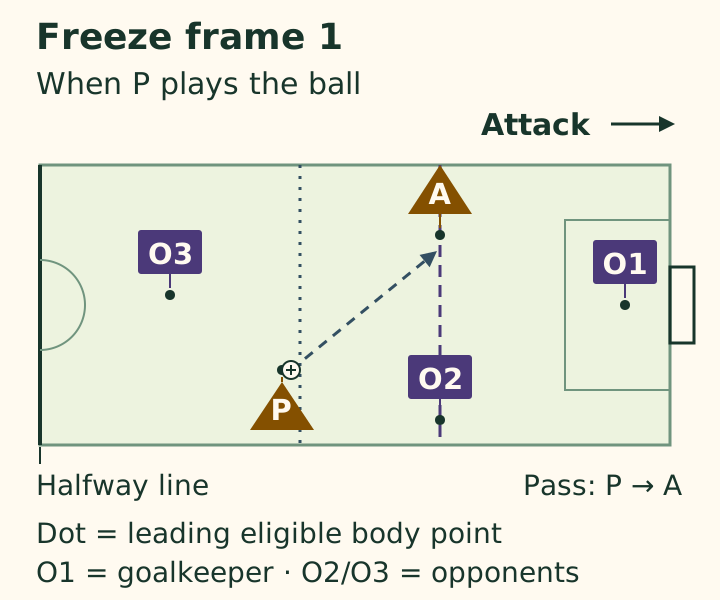
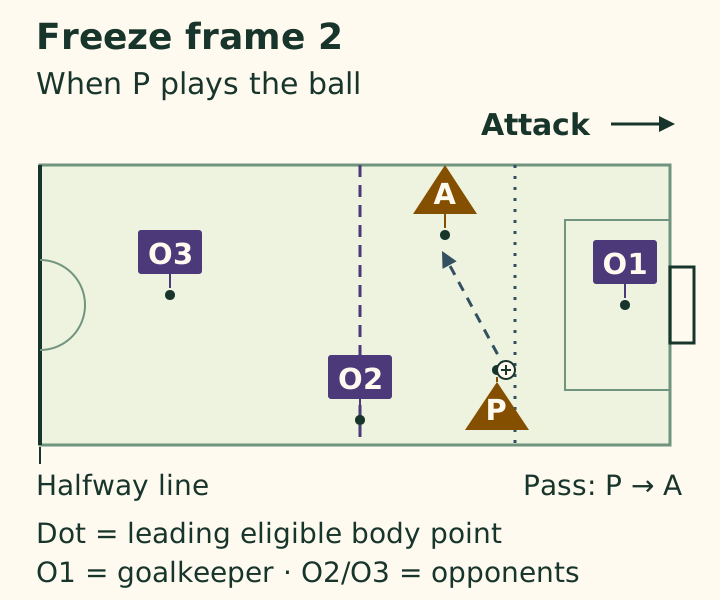
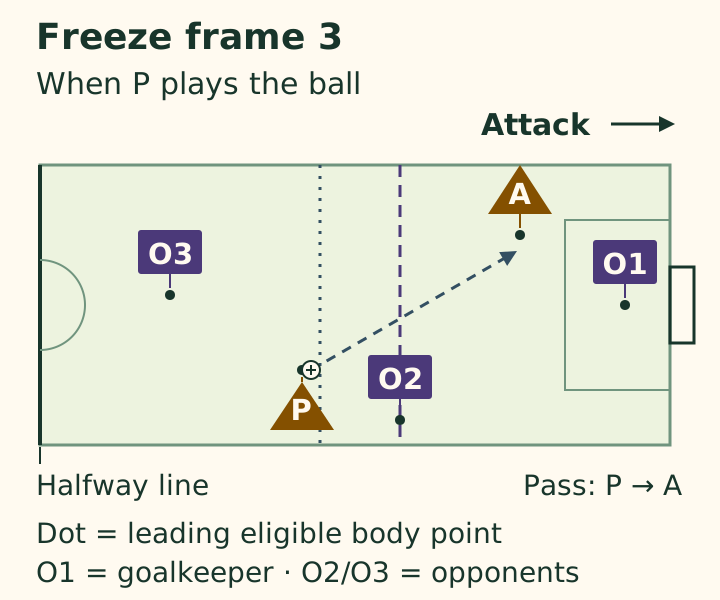
All three drawings show the opponents’ half, with the attack moving right. A is the intended receiver; P makes the pass. O1, O2 and O3 are opponents. O1 is the goalkeeper here, but a goalkeeper does not have to be the opponent closest to goal.
The small player dots mark the foremost body point that counts for offside. The larger letter shapes are labels, not bodies. These are schematic positions, not a method for measuring a television replay. Compare each dot with the two reference lines.
In every case, assume A receives P’s pass directly, with no intervening touch or other incident. The dashed arrow shows that later pass; the player marks show the earlier frozen instant.
Frame 1 — the same line
A and O2 share a reference line. O1 is nearer goal; O3 is farther away. The ball is still well behind A. Does standing level with O2 leave A enough room?
Frame 2 — the ball is farther forward
In this scene, A is beyond O2. P and the ball are even nearer goal than A. Look at the ball’s line before making your decision.
Frame 3 — beyond both lines
A is beyond O2 again, but the ball is behind O2. There is empty space ahead of A. Which two comparisons matter before the pass reaches that space?
Your call: which reception is an offside offence?
A receives the direct pass in each case. Make your choice, then open “Answers and explanations” or read the worked answers below. All explanations are available without the buttons.
Answers and explanations
- Frame 1: A is level with O2. Being ahead of the ball alone is not enough.
- Frame 2: A is behind the ball. Being ahead of O2 alone is not enough.
- Frame 3: A is beyond both reference lines at the pass, then plays the ball.
Why only frame 3?
Frame 1: no offside offence. A’s dot sits on O2’s line. A can run forward after the pass and receive beyond that line; the later run does not change the earlier position.
Frame 2: no offside offence. A is closer to goal than O2, but the ball is closer still. The tempting shortcut “past the defender means offside” fails here.
Frame 3: offside offence when A receives the ball. At the pass, A is beyond both lines in the opponents’ half. Playing that pass supplies the involvement missing from a frozen picture alone.
Try changing one thing: move the ball’s line just beyond A in frame 3. Without moving a single opponent, you have removed A’s offside position. Now move A back to O2’s line instead. That also changes the answer.
Position is only the first question
Being in an offside position is not an offence by itself. In this exercise A then plays the pass. In a match, interfering with an opponent can also matter, even without touching the ball—for example, clearly blocking the goalkeeper’s view.
Do not extend these three direct-pass cases to every rebound or defensive touch. Deliberate play, deflections and saves require the fuller rule. Nor is the ball’s travel direction alone the test: use the player’s position at the relevant teammate contact.
Three exceptions, and a useful replay habit
There is no offside offence when a player receives the ball directly from a goal kick, throw-in or corner kick. Our drawings show ordinary passes during play.
On your next replay, try this order: find the teammate’s contact, locate the ball and second-last opponent, then watch what the receiver does. If the contact instant or body positions are hidden, leave the decision open.
This introduction follows IFAB Law 11, 2026/27, checked on 25 October 2026. It covers the basic position test and direct reception, not every refereeing case or experimental competition rule.